Pinterest for Brand Designers in 2026: More Traffic, More Leads, More Dream Clients
If you grew up somewhere along the Tumblr to Pinterest pipeline, Pinterest probably raised you a little bit. It gave us wedding boards before we had driving licences, bedroom ideas for houses we did not own, hairstyles we fully intended to try and approximately 900 outfits saved under a board called style. We knew how to use Pinterest for inspiration. We knew how to fall into a very specific rabbit hole at 1 a.m. But using it to market a business? That took a little longer to click.
So, welcome to Pinterest’s business redemption arc, in 2026, Pinterest is far more than the place you keep your imaginary Paris apartment. For brand designers, freelancers and creative studios, it can become one of the most useful long term marketing tools in the room - a searchable home for your work, a steady route back to your website and a way to be discovered by potential clients all over the world. Unlike the marketing advice that begins with “post four times a day, launch a funnel by Tuesday and wake up at 5 a.m.”, this is a much calmer plan.
You already have most of the content. We are simply going to help more people find it.
Why Pinterest makes so much sense for brand designers
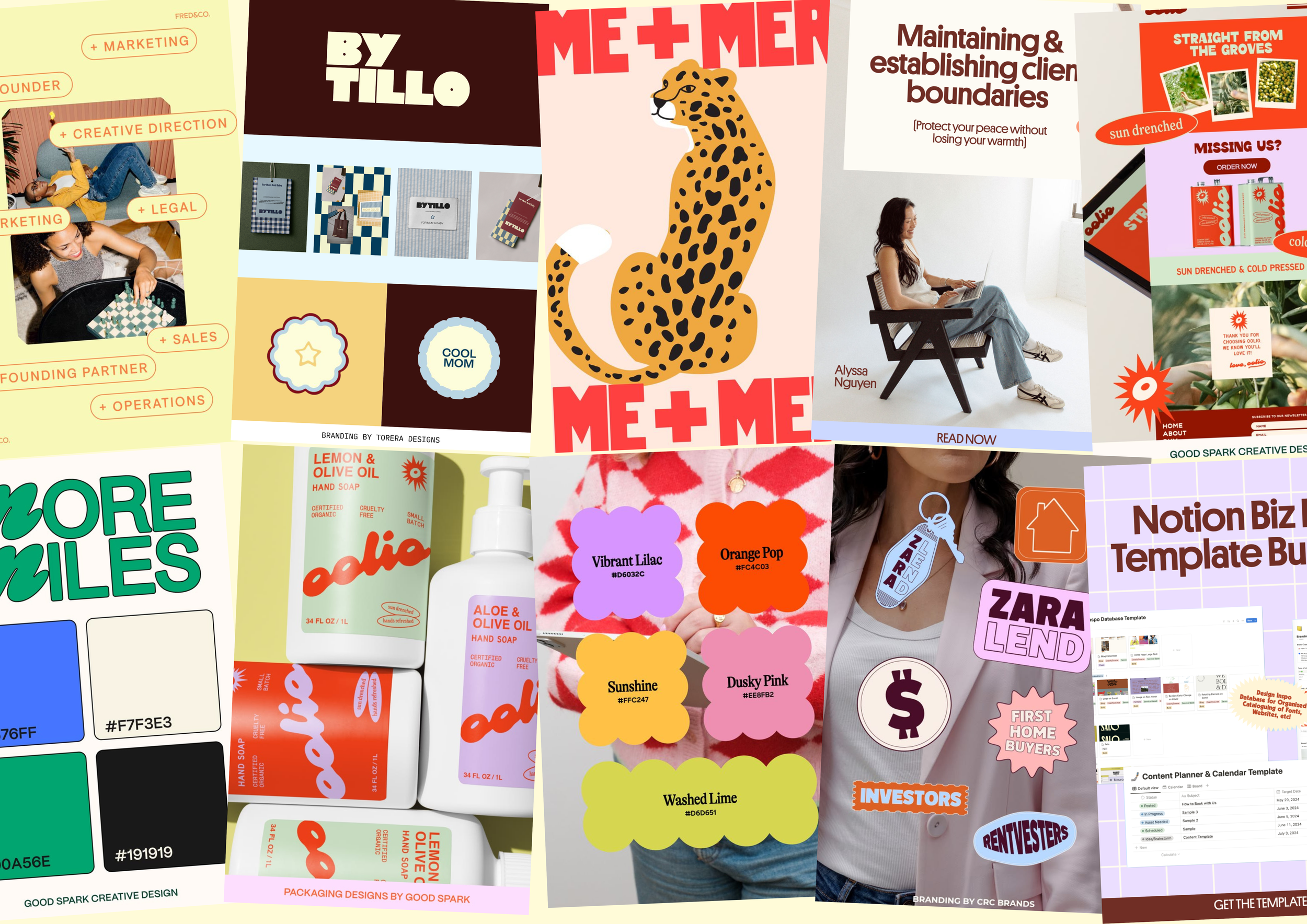
As a brand designer, you are sitting on the exact kind of work Pinterest was built for. Logos. Colour palettes. Packaging. Illustrations. Website layouts. Type combinations. Moodboards. Brand guidelines. Before and afters. Mockups. Tiny details from a project that never made it onto Instagram because you could only squeeze so much into one carousel.
On Instagram, a project often gets one big reveal and then the feed moves on. Pinterest works differently. Pinterest says a Pin can start gaining engagement hours, days, months or even years after it was first published.
That means the branding project you completed six months ago does not have to disappear into an old client folder. It can keep circulating, keep being searched and keep introducing your work to people who have never heard of you. Pinterest is not waiting for someone to follow you before showing them your work. It is waiting for them to search for something you happen to be brilliant at.
That might be:
Showit website design
Colourful branding for a food business
Squarespace website for a fashion brand
Bold logo suite
Playful packaging design
Editorial brand identity
Showit website designer
Your future client could already be typing in the thing you do. Your job is to make sure your work has a chance of appearing when they do.
Your website is the whole point
Pinterest is not meant to become another platform you maintain purely for the joy of watching a number go up. The real goal is to bring the right people back to your website..Your website is your digital home. It is where someone can see the full project, understand your process, read about your services, get to know you and eventually enquire.
Before you start creating Pins, check that your website is ready for those visitors.
Is your best work easy to find?
Do your service pages clearly explain what you offer?
Is there an obvious way to enquire?
Do your case studies show more than three final mockups?
Does the site still sound and look like your studio today?
Does it work properly on mobile?
Do not send every Pin to your homepage simply because it is convenient. A Pin about a colourful shampoo identity should lead to that project or case study. A Pin about Showit versus Squarespace should lead to the full blog post. A service led Pin should lead to the relevant service page. The closer the page matches what someone clicked, the easier it is for them to keep exploring. Pinterest is the road sign. Your website is where the actual date happens.
One branding project is not one piece of content
This is where brand designers have a frankly unfair advantage. Let us say you created the identity for a shampoo brand. Inside that one project, you probably have:
The primary logo
Secondary logos and submarks
A colour palette
Typography
Illustration or iconography
Packaging concepts
Bottle and box mockups
A moodboard
Brand strategy excerpts
Art direction
Social media applications
A website or landing page
Behind-the-scenes sketches
The final case study
Instagram might receive one launch carousel and a Reel. Pinterest can give every one of those details its own moment. You could create:
A full-project Pin
Individual logo Pins
A colour palette Pin
A “bold shampoo branding” Pin
Several packaging close-ups
A website scroll
A typography detail
A moodboard
A before-and-after
A Pin linking to the case study
A Pin explaining one strategic decision
A service Pin using the project as proof
One client project becomes 15, 20 or even 30 pieces of Pinterest content. Please open those client folders. Your content is in there, waiting for a second life.
Talking about Pinterest without mentioning blogs would be rude
If you are a brand designer who loves to yap, explain and share opinions, please give those thoughts somewhere permanent to live. Blog posts are brilliant Pinterest content because they answer questions your potential clients are already asking and bring them directly to your website for the answer.
Imagine you design both Showit and Squarespace websites. A potential client does not know which platform suits them. Instead of explaining the same thing from scratch in every enquiry email, you can send them a thoughtful blog post comparing the two.
That post helps the client. It demonstrates your expertise. It makes the decision easier. And it can keep bringing new people to your site through several Pinterest Pins.
You could write about:
Showit versus Squarespace for a service business
What actually happens during a rebrand
How much professional branding costs
The difference between a logo and a full visual identity
What to prepare before hiring a website designer
How to know whether your business has outgrown its current brand
A behind-the-scenes case study of a recent project
One useful blog post can become multiple Pins with different headlines, images and entry points. More ways into your website, without writing a new article every Tuesday for the rest of time.
What this looks like for real design studios
Over the past five years, we have managed Pinterest for some genuinely brilliant brand designers and studios, including Olive St. Studio, ATNN Design, Good Spark, Nabi Studio, Fred & Co, Buzz and Banter, Hey Girl Studio & so many more.
Each studio has its own visual language and specialism. That is exactly why the strategy cannot be “use this one Pinterest template and hope for the best.” For one studio, the strongest discovery route might be colourful CPG packaging. For another, it might be Showit websites, editorial layouts, resources for designers or bold identity work for a very specific kind of founder.
The goal is not to make every studio look like a Pinterest trend. It is to understand what makes its work desirable, then build enough useful pathways for the right people to find it.
Okay, but how does Pinterest turn into actual enquiries?
There is no secret hack hiding in this section. It happens through useful work, search intent, consistency and time. Pinterest places your work in front of people beyond your existing audience. That matters enormously when you are a service provider who can work with clients across cities, countries and time zones. Founders, creative directors, marketers and other designers are already using Pinterest to plan brands, websites, launches, packaging and campaigns. When your work repeatedly appears during that planning process, familiarity begins to build.
Someone might save your Pin today, visit your website next month and enquire three months later when the project finally has a budget. Pinterest will not always produce a neat, immediate journey and that is exactly why consistency matters.
If someone searches “Squarespace design for a fashion brand,” you want to be there. If they search “bold branding for a drinks company,” you want to be there too. If they click through, fall into three of your case studies, read a blog post and decide that your studio is suddenly the only one they want? Lovely. That is the whole point. The more high-quality, relevant work you publish, the more searchable doors you create into your business.
What should you actually measure?
Pinterest offers plenty of numbers, but you do not need to stare at all of them. Monthly views can be nice little ego confetti. They are not the entire story. Pay closer attention to:
Outbound clicks: Are people leaving Pinterest to visit your website?
Top Pins: Which projects, subjects, headlines and visual styles generate action?
Saves: Which work do people want to return to?
Website referral traffic: Is Pinterest bringing more people into your site over time?
Enquiries: Are people mentioning Pinterest when they get in touch?
Add “How did you hear about us?” to your enquiry form and include Pinterest as an option. It is a very simple way to catch journeys that analytics cannot always explain neatly. Then review the account once a month. Look at what is getting clicked and saved, create more entry points around those subjects and keep going. We are looking for patterns, not refreshing the dashboard every 45 minutes.
Want a Pinterest best friend without doing all the Pinterest work?
If you are ready to build an evergreen route from Pinterest to your website, but would quite like someone else to handle the strategy, design and details, hi. This is very much our thing.
Pinterest in a Week is our focused one-week setup for brands that want to get their Pinterest foundations, strategy and content moving without committing to monthly management.
+ with Pinterest Management, the I take care of the ongoing plan, Pin design, strategy and publishing, so you can go and design the next brilliant brand instead.
[Explore Pinterest in a Week ]
[Explore Pinterest Management ]
Stay spicy,
Kriti xx